 

He started his career as a groom at the local riding stables which, through his dedication and determination, he now owns jointly with his wife, Wilma, and it is one of the most beautiful and professional establishments in Europe. The Dutch national championships are held there every year and it is an achievement of which Henk is extremely proud. He explains that his international training commitments take him away from home for much of the time but it is at home that he is at his happiest, working with his horses and enjoying their progress. The stable has 28 horses at any one time. The three trainers who have had the greatest influence on Henk's career have been Ernest van Loon, George Thedorescu and Piet Oothout. It took however, a conscious decision by Henk to focus his attention on a career as a professional trainer, rather than a rider. This decision was partly dictated by finances and his need to develop the business but, he added with a smile, his over-competitiveness was not conducive to the international scene. As a full-time trainer he can dedicate his time solely to his pupils at the competitions but, he says, even to this day, they are often to be found happily drinking beer while he is still pondering over a disappointing performance.
 Interested in expanding your business at home and abroad? This publication is being read by horse lovers all over the world. Contact us now for full details and our advertising rates.
Email: joy@field-galleries.co.uk or Click Here
His first requirement is that the horse must be forward but with careful attention to the rhythm. A horse that is running, is not forward in front of the leg. From this he will put the horse on the bit and the result of this is to create the balance. This balance will be different for each horse but the rider must be able to manage the horse and put him in the position to create this. Out of the balance he will create the suppleness and finally, the self-carriage. He was enthusiastic about the concept of the training programme in England. He said, the idea is perfect. Henk was the first ever national coach in Holland and from this, the showjumpers and eventers followed suit, but he said, the concept had been in practice for many years in Germany and we are all still behind them. The riders need support, he explained, they need somebody they can trust and ask for help. More importantly, they need to feed from each other, particularly the group not already competing regularly at international level. He said these riders can sometimes become a little isolated because they are depending only on what is happening in this country and do not have the benefit of what is happening abroad. For this reason, at the end of each training session, Henk discussed with the riders as a group, the problems he had been working with. His ability to communicate with each combination was remarkable. He was honest, yet diplomatic and possessed such an inner sense of vision, that he appeared to climb inside each horse and rider's head to understand them completely. When asked about his plans for British riders, he said, "It was a little early and he did not have enough information to give an exact schedule but, Britain now has very good horses and riders and I really believe with this kind of support, it must bring great progress to the results of the British riders." The 2000 Squad comprises rider (& horses) being primed for international competition from the year 2000 onwards - these being:
Nicky Barrett (Cerruti) Our grateful thanks to "Dressage News" for permission to reprint this article. Dressage News is the official magazine of British Dressage. Please Click Here for more details.
|
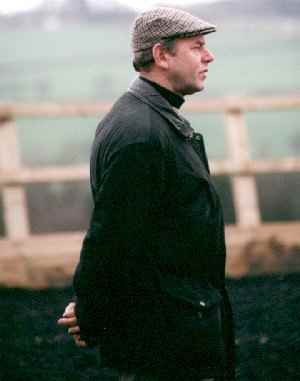 Henk van Bergen was born in Nijmegen, Holland, the son of a baker. He recalls his love of horses from a very early age and yet, to this day, he has no idea why. Brought up in the city, he was expected to follow in his brothers and sisters footsteps by continuing his education at university. However, Henk had other plans, he was determined to make a career with horses, although at that time, he had no idea the path that this would take.
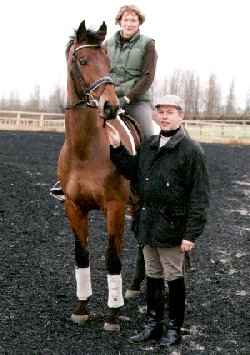 Henk was appointed Dutch National Trainer in 1988 and took his team to silver medal position at the Barcelona Olympics. He said this was his greatest moment of glory, but that his total commitment as national coach made the four years leading up to this result, particularly stressful and to end, he said, in just one day of joy. It is clear that Henk is a man of great integrity. His training methods are guided by a strong code of ethics and principles, which makes him one of the most highly respected trainers of our time. He explained, if there is a group of top trainers, he would wish to be in that group, but not to sit in the front row. It is nice to sit there occasionally, but to maintain that position would mean breaking with his own standards of morality and this he could not do. Winning is not the ultimate goal, it is achieving the result without any compromise of one's own principles and beliefs. The fundamental principle of Henk's training is quality. He said anybody can train tricks, that is not difficult, but to produce the movements with the quality of expression he is looking for, requires true harmony between horse and rider. This harmony is created by looking at the training as a whole picture and not as an isolated event. The horse must be happy and produced in a stress-free environment, but this does not mean lots of pats and tit-bits. A horse will not work to the best of its ability just because it is fond of the rider, he must work because he respects the rider but never out of fear.
