 
A Background History

Logical, systematic, as well as humane, methods of training, date back as far as the 5th Century BC and the earliest surviving literature about these systems was produced by Xenophon. These remain as a model for the classic riding of today. ‘Dressage' put simply is the training of the horse to use his body with the suppleness and control of an athlete aligned with the grace of a ballet dancer. The goal is that of achieving perfect performance, this in itself being a wonderful and fascinating experience for the rider who is able to develop these facilities in a horse. The two should then work together in harmony. The development of some of these arts for entertainment played an important part in the mediaeval age of Chivalry, i.e. tournament riding, jousting, tilting, etc. This encouraged the aristocracy and nobility to improve their horsemanship. The re-birth of the skills and arts of classical Greece took place in Italy with the first modern academy founded in the early 1500s. Progress brought about the inception of new schools, the two most important of which were: firstly The Spanish School now in Vienna, and later Samur in France. The Spanish School stands alone as the pre-eminent academy dedicated solely to the preservation of the classical art of riding.
 Interested in expanding your business at home and abroad? This publication is being read by horse lovers all over the world. Contact us now for full details and our advertising rates.
Email: joy@field-galleries.co.uk or Click Here
Not until the reinstatement of the Olympic Games in 1896 did an element of competition come into being and these were more a test of obedience than gymnastic ability and training. The continentals took up competition with much the same enthusiasm as they had for Haute Ecole displays at court. From early 1900 the system of competition evolved into the format we use today under the auspices of the FEI (Federation Equestre Internationale). In the earlier years of the present system Britain fell behind its continental partners in the execution of the art, whilst tending to excel in other fields of equestrianism. European countries with little interest in hunting began to specialise and consequently excel in the art of producing horses to a high standard of training. In present times Germany is the nation at the forefront of competitive dressage and their systems of training have been utilised by many other countries, including Britain.
THE DRESSAGE GROUP, formed in 1961, was initially incorporated in what was then the Combined Training Group. Dressage became an independent discipline in 1973 with a membership of less than 15 - and only 21 affiliated competitions. By the end of 1991 this had dramatically increased to almost 7,500 members with 4,900 horses registered and 753 days of affiliated competitions. One of the most significant steps in Great Britain's conversion to dressage came in 1973 when the first major international competition was staged at Goodwood, under the direction of the now Duke and Duchess of Richmond and Gordon. The British enthusiasts were given the opportunity of seeing the best exponents of dressage from overseas. In 1975 Goodwood hosted the Alternative Olympics which also brought us the best competitors from all over the world. Since then dressage in this country has become a major participation sport and is currently the fastest growing equestrian discipline. Next to Germany, it is thought that Great Britain has the largest number of participants in the sport of dressage in the world. Great Britain are world leaders in eventing and show jumping and there is absolutely no reason why we cannot also be leaders in dressage. As our hunting and racing background is so strong, we have an abundance of top quality horses to supply our top riders in these disciplines. Dressage horses are really a different type and on the whole the British thoroughbred is not 100% suitable. A dressage horse must first and foremost be an athlete, have three good paces and, not least, have the temperament to take the intensive training that is involved. Today, the best horses with dressage potential are bred on the continent. It is interesting to note that at the big European High Performance sales over the last few years, the dressage horses have often commanded the highest prices, over the other discipline horses. This situation will change in Great Britain as there are now people who are starting to breed especially for the dressage market. This will reap rewards in the long term but we still have a shortfall at present. Even recently the High Performance sale at Stoneleigh is worked on the same lines as those in Europe and is reaping excellent results.
The dressage scene in Great Britain is very exciting at the moment with an enormous increase in the number of people becoming involved. Top quality horses are coming along with an influx of talented young riders - the champions of tomorrow. The dressage explosion is just around the corner. To aid and abet this explosion sponsors are always needed to help the most talented to achieve these results in the shortest possible time. Once we are winning on an international level, dressage in this country will enjoy the high profile it now has in Europe. Success breeds success.
|
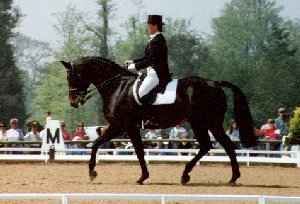 Dressage is a highly specialised equestrian ‘Art'. The word derives from the French verb ‘Dresser' which basically means to train. This therefore implies the process of techniques used in the production of a horse to perform the artistic movements.
 So - dressage as we now know it is the art of training a horse to give the impression of doing of his own accord what is required of him. This applies from the lowest levels where the horse is expected to walk, trot and canter in circles and straight lines, to the very highest level where the intricate movements such as piaffe, passage and pirouettes are performed. Great pleasure can be derived from training a horse to respond confidently to the rider's every wish, and such training is an extra asset when the horse is asked to perform other equestrian activities such as show jumping or eventing.
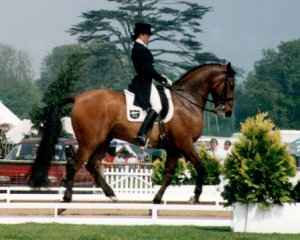 There are no short cuts in dressage and there has been an increase in dressage trainers in this country to handle the increased interest in the sport. However, not all these trainers have brought horses to Grand Prix level themselves and therefore horses and riders often need to have financial backing to train in Europe. Riders need to have many years of experience before they can take a top quality horse, bred for the job, to the top level. Even so, this success will normally only be achieved if the horse and rider have been under a top professional who has ensured that the horse has been working correctly at every level.
