

 |
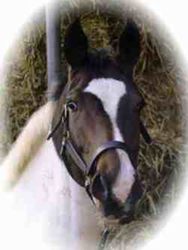
Poland has in recent years become another source of beautiful coloured Warmbloods, many carrying rare old Trakehner blood. There was a popular line within the Trakehner breed which produced stunning coloured Trakehners. Sadly this line was lost during the second world war, but appears in the Pedigrees of many coloured Wielpolska horses ( Polish Warmbloods). When you look at heads such as the one of this mare then it is easy to see the Trakehner influence.
 |
| Whilst most Native Breed Societies in Europe do not accept broken coloured animals in their studbooks, in the Shetland and the Icelandic they are not just tolerated, but actively bred for. |
Furthermore we have coloured specimen popping up in some of our native breeds and Ponies. It is rather peculiar how some breed societies will not tolerate any excessive white markings, while others welcome and specifically encourage and highly regard coloured strains within their breeds. Both the Icelandic and Shetlands will happily register and approve coloured horses, and specifically the Icelandic, with their vast range of base-colours, produce some stunning coloured horses which are greatly soughtafter.
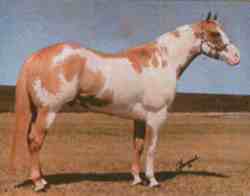 |
| This very typey Paint stallion is showing the Quater Horse heritage of his breed very clearly. Isn't this just the kind of horse we imagie the Native American Indians riding across the prairie on? |
Of course the horses with the highest number of coloured specimens is the American Paint or Pinto. This is where we find Tobianos and Overos, mostly horses that look like colourful versions of the popular Quarterhorse. The Americans also breed almost pure-bred coloured Arabs, Saddlebreds and Tennessee Walking Horses, as well as other gaited horses such as the Missouri Foxtrotter, and Ponies of all shapes and sizes.
So, now you'd like to breed yourself a coloured foal ?
Well - in the case of the Tobiano we have to start with one coloured parent at least. Whilst this may be an obvious statement on the surface - it is a fact that you could breed two solid coloured horses with Overo genes and still get an Overo out of it. This is not the case with the Tobiano gene, it is a dominant gene and therefore every horse with a Tobiano gene will be coloured. Sadly it is impossible to actually see if a Tobiano carries one of those priced "colour" genes, or maybe two. This is of interest as a horse with a double set of Tobiano genes will produce a coloured foal regardless of the markings of the other parent, whilst those with only one Tobiano gene will only produce 50 % coloured offspring when crossed to a solid coloured horse.
Never EVER believe anybody who tries to tell you that a particular stallion produces 80 % (or whatever) coloured foals out of solid coloured mares – it might be true that this has been the stallion's tally so far - but even then your statistical chance of a coloured foal out of a solid mare will be 50 %. A coloured horse will either be something called "heterozygous" for the Tobiano gene - meaning he has one of a pair of genes that is responsible for the Tobiano pattern - or "homozygous" for the Tobiano gene, which means he has a double set of the gene which is responsible for the Tobiano patter. A heterozygous parents has a gene set of Tt (one T for the Tobiano gene, one t for the solid gene) and will produce 50 % Tobiano offspring from a solid partner. A homozygous patent has a gene set of TT ( both T for Tobiano genes) and will produce a Tobiano offspring regardless what colour the other parent is.
As each parent gives it's foal ONE of those genes, it takes two coloured parents to produce a homozygous (TT) horse. Hence a horse with one known solid parent can never be homozygous for the Tobiano gene and therefore will only produce 50 % of coloured offspring to solid mares.
A solid foal by two Tobiano parents can not - contrary to popular belief, produce any colour itself, or rather, no more than any other solid coloured horse. Had it been given a T from either parent then it would, itself, have been a Tobiano. The fact that it isn't means it does not posses that prices T gene, and can therefor not pass it on.
The easiest way to understand the way the tobiano genes are passed on is by way of a simple grid : Say we have one solid coloured parent - who will be tt (both genes solid,) and a coloured stallion, who we will assume is Tt (one Tobiano, one solid gene). The mare's genes are across - the stallion's down, the possible foal combinations in between
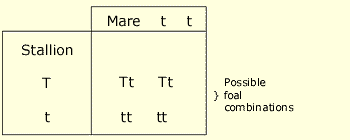
This gives us 4 outcomes - two are Tt ( a solid gene from the mare, a Tobiano gene from the stallion) two are tt ( a solid gene from the mare and a solid gene from the stallion)
So this particular crossing would give us a 50 % chance of a Tobiano, a 50 % chance of a solid foal.
Let's do this again with two heterozygous horses, again we have the mare(Tt) across, and the stallion (Tt) down

Now we have three different possible outcomes. We again have 2 times Tt - meaning a 50 % chance of a heterozygous Tobiano foal We have 1 tt - meaning a 25 % of a solid coloured foal and we have 1 elusive TT - meaning a 25 % chance of a homozygous Tobiano - who will subsequently produce colour with anything he he Crossed with.
Let's just do one more - this time using our homozygous (TT) horse from the last calculation, and crossing him with a solid (tt) mare

Here we see that we have ended up with 4 x Tt - Tobiano foals only - all of which will be heterozygous.
As you can see it is actually rather simple to predict what chances of a tobiano foal you have with any given parent combination. However, what can never be guaranteed is what type of pattern you'll get, and whether your foal, coloured or not - is going to grow into the horse you ultimately wanted.
Breeding any horse, coloured ir not, is a huge responsibility, and when you are breeding for colour this responsibility is, if anything - even greater. What if your foal ends up solid ? Will you still want it ? When you choose a stallion for your mare - ask yourself : "If this horse was plain bay – would I still want to breed my mare to him ?" If the answer is "no", walk away. There are always coloured youngsters on the market, and it can often be cheaper to buy a youngster than to attempt to breed one. And at least when you buy your youngster, you know what you're getting - so think twice before you rush your mare to the nearest available coloured stallion.
I'm perfectly happy to answer any questions on coloured horses, if you think I can possibly help, just e-mail me on petra@lancia.demon.co.uk

Click Here
or send an email to
joynext@field-galleries.co.uk
to be notified when the next issue
of the magazine is published
If you wish to get in touch about another matter then please use the contact form